

Lithium-Germanium Alloy Interfaces for Efficient Low-Pressure Ammonia Synthesis
摘要
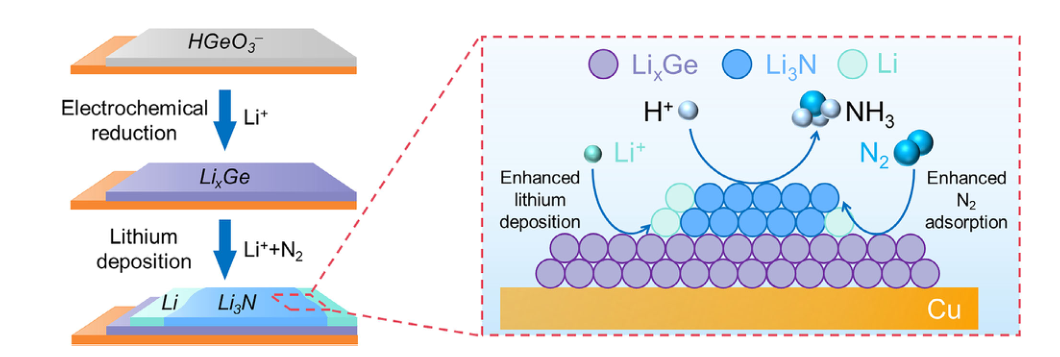
The lithium-mediated nitrogen reduction reaction (Li-NRR) offers a sustainable pathway for ammonia synthesis, providing a viable alternative to the energy-intensive Haber-Bosch process. While most prior studies focused on solution-phase optimization, we introduce a transformative electrode engineering strategy via the rational design of triethylammonium germanate-modified copper (Cu/TEG) electrodes. Multi-technique characterization reveals the formation of the Li15Ge4 alloy during the Li-NRR. Electrochemical measurements combined with DFT calculations demonstrate that the Li15Ge4 alloy simultaneously facilitates lithium deposition and shifts the N2 adsorption energy more exothermic. Most importantly, this interfacial engineering enables a Faradaic efficiency (FE) of up to 92.5% at an unprecedented N2 pressure as low as 4 bar and with minimal overpotential relative to the onset of lithium deposition. This synergy minimizes energy losses, achieving the highest reported pseudo-energy efficiency value (17.6%) in a batch cell to the best of our knowledge. Overall, this work establishes dual-function interfacial engineering via lithium-germanium alloy formation as a breakthrough strategy, moving beyond conventional solution-phase optimization to provide a new approach for efficient electrochemical nitrogen fixation.