

Panchromatic solar absorption enables multi-photon CO2 carboxylation: Mechanistic insights in consecutive photoinduced electron transfer
摘要
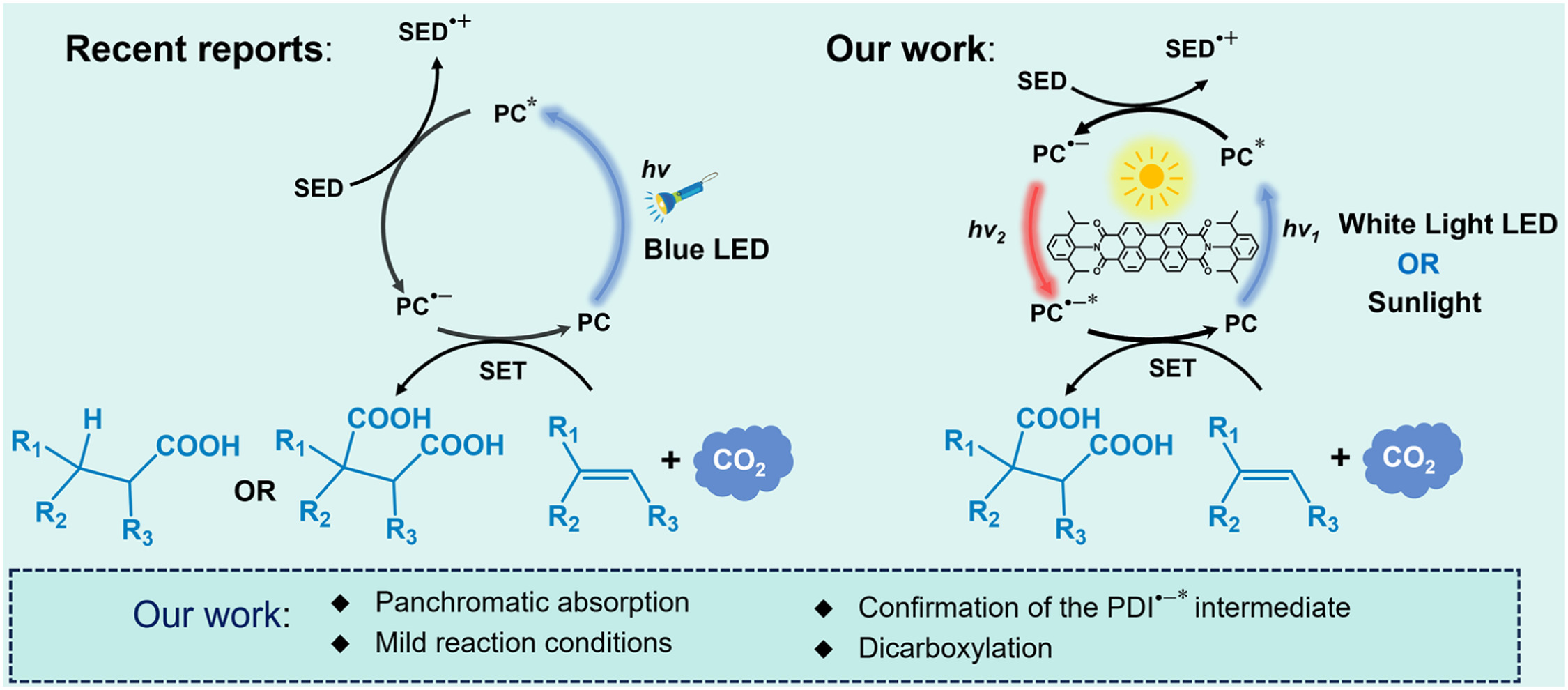
Inspired by natural photosynthesis, visible-light-driven carboxylation of carbon dioxide for the synthesis of value-added chemicals has attracted considerable attention. However, the current limitation in carboxylation lies in the narrow absorption range of the photocatalysts used. These photocatalysts are predominantly activated by blue light, limiting the utilization of most of the solar light. Herein, we employed the organic dye N,N-bis(2,6-diisopropylphenyl)perylene-3,4,9,10-bis(dicarboximide) (PDI), along with its single-electron-reduced state PDI•− through consecutive photoinduced electron transfer (ConPET), effectively absorbs panchromatic solar spectrum for photocatalytic dicarboxylation. Mechanistic investigations using femtosecond time-resolved transient absorption (fs-TA) spectroscopy unequivocally identified the excited state of the singly reduced species, PDI•−*, rather than the doubly reduced form, as the key intermediate responsible for the reductive activation of alkenes. Furthermore, efficient solar-driven carboxylation of CO2 was successfully demonstrated under natural sunlight irradiation, underscoring the practical potential of this photocatalytic system.