

Rapid Hole Extraction Based on Cascade Band Alignment Boosts Photoelectrochemical Water Oxidation Efficiency
摘要
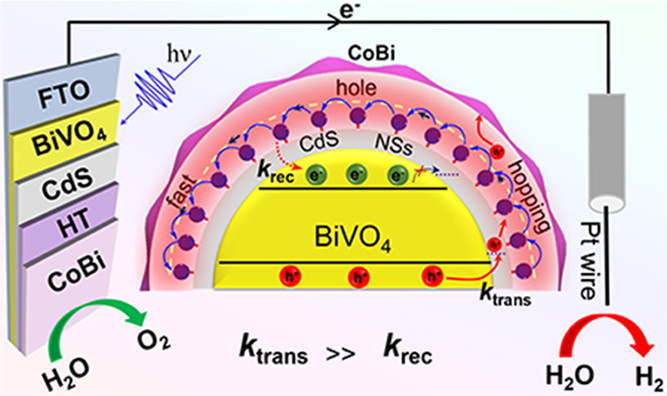
Photon energy loss to interfacial charge recombination is one of the key challenges to achieving high efficiencies for solar water splitting in photoelectrochemical cells (PECs). Herein, BiVO4-based photoanodes are constructed, where BiVO4, cadmium sulfide nanosheets (CdS NSs), hole transport molecules (HTs), and oxygen evolution cocatalysts (OECs) assemble sequentially in a cascade band alignment for efficient photogenerated hole extraction and accumulation to OECs. In the photoanode assemblies, CdS NSs act as energetic barriers to suppress surface recombination. Thiolate-functionalized aryl amine HTs that anchor to CdS NSs are interfacial-charge-transfer mediators that efficiently extract the photogenerated holes. The oxidized HT (HT+) hops isoenergetically among adjacent HTs and finally accumulates oxidative equivalents to OEC. Transient absorption spectroscopy along with intensity-modulated photocurrent spectroscopy proves that HTs and CdS NSs accelerate hole-transfer kinetics and suppress recombination of surface-accumulated holes and electrons. Among the three HTs, triphenylamine shows the best performance. The best-performing photoanode assembly exhibits increased photocurrent density from 0.87 to 5.2 mA/cm2. The molecular approach to hole extraction from BiVO4 photoanodes provides a promising avenue for efficient photogenerated charge separation and collection to optimize the performance of PEC for water splitting.