

Effect of ESIPT-Induced Photoisomerization of Keto–Enamine Linkages on the Photocatalytic Hydrogen Evolution Performance of Covalent Organic Frameworks
摘要
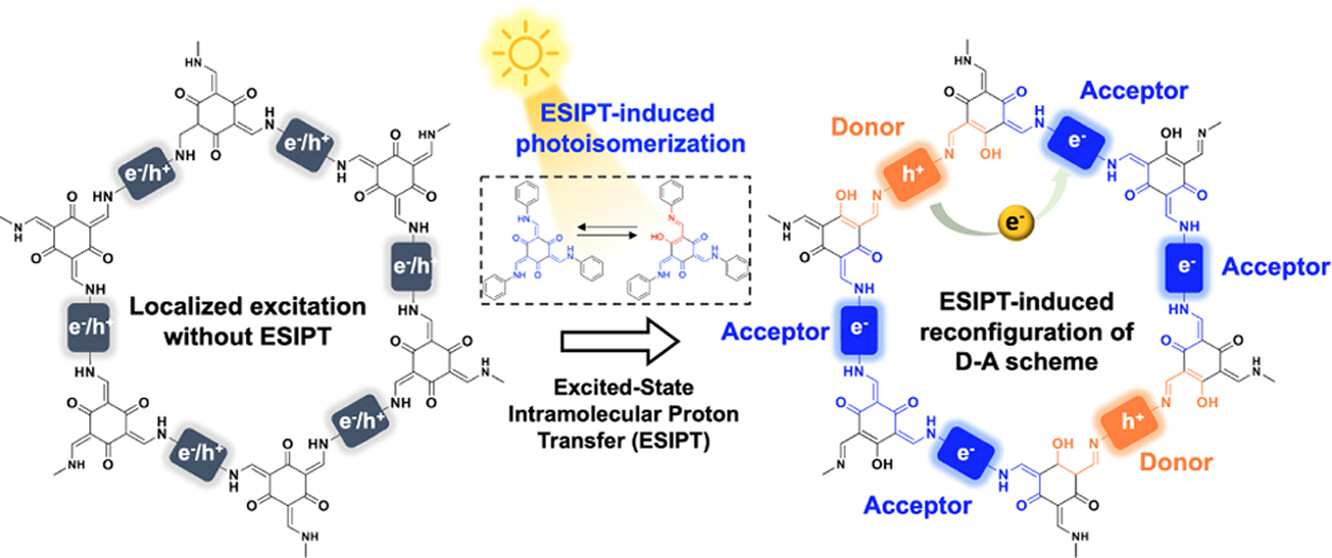
Photoexcitation of keto–enamine allows intramolecular proton transfer from C–NH to C═O, leading to tautomerization, while the photogenerated isomers are excluded from the study of photocatalytic applications. Herein, we demonstrate the photoisomerization of keto–enamine linkages on covalent organic frameworks (COFs) induced by excited-state intramolecular proton transfer (ESIPT). Partial enolization generates partially enolized photoisomers with a mixture of keto (C═O) and enol (OH) forms, conferring extended π-conjugation with an increase in electron density. The spatially separated D–A configuration is thus rebuilt with the enol–imine-linked branch as a donor and the keto–enamine-linked branch as an acceptor, and in turn, the photoinduced charges transfer between the two adjacent branches with a long lifetime. We further prove that the partially enolized photoisomer is a key transition instead of the keto–enamine form as an excited-state model to understand the photocatalytic behaviors. Therefore, ESIPT-induced photoisomerization must be considered for rationally designing keto–enamine-linked COFs with enhanced photocatalytic activity. Also, our study points toward the importance of controlling excited-state structures for long-lived separated charges, which is of particular interest for optoelectronic applications.